Product: AI Claims Concept
Transforming Claims Processing with AI-Powered Automation
A self-initiated concept exploring how agentic AI can make insurance claims more transparent, faster, and more human. Designed in one day.
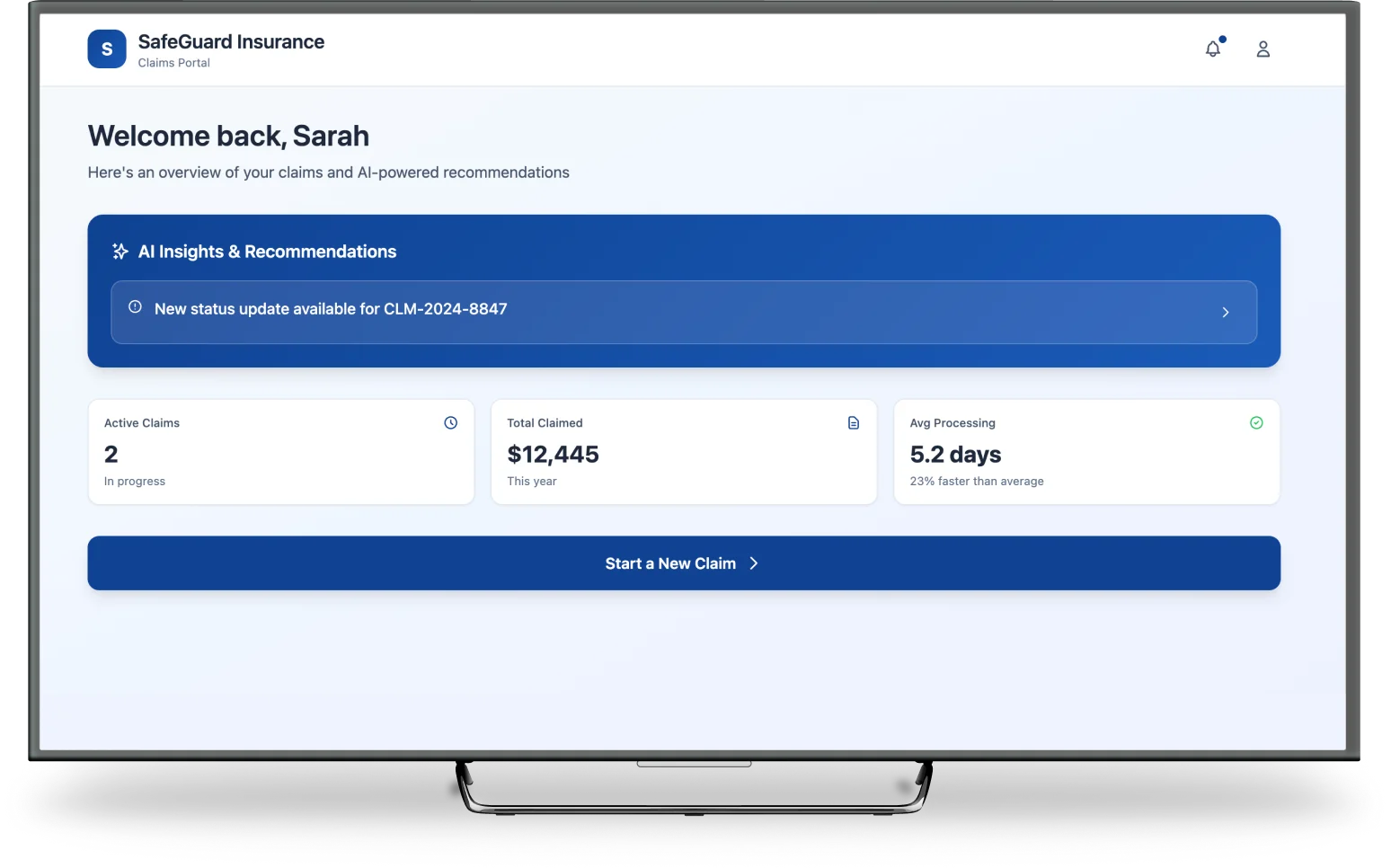
Filing a claim should be simple, but it rarely is.
The process is manual, the guidance is sparse, and there’s no clear signal that what you submitted is complete or correct. It’s a stressful moment made harder by the systems meant to help.
The challenge: simplify the experience without sacrificing accuracy or control.
Three Friction Points Worth Solving
Pain points
- Long, manual data entry
- Lack of real-time guidance or status clarity
- Low confidence in whether the claim is complete or accurate
AI-Human Collaboration Model
This model improves efficiency while reinforcing trust and transparency. The AI does the observing and suggesting. The user does the deciding. The system does the explaining. Each step is designed to feel helpful, not authoritative.
One User at the Front. Many Stakeholders Behind the Scenes.
The insured is the sole direct user of this experience, but they sit at the front of a much larger operational chain. Adjusters, supervisors, and compliance teams never interact with this interface, yet their needs define what “good input” looks like. This concept focuses on improving the insured’s experience while acknowledging the downstream realities it must support.
(Direct hands-on users of the AI claims platform)
(Operational, compliance, and product oversight)
Inside the Design Thinking
AI ObservesI designed the flow so the system quietly does the heavy lifting in the background. It analyzes photos, detects key details, and prepares the information a user would normally have to enter manually. This reduces effort without adding cognitive load.
The system offers prefilled details and recommended next steps based on what it sees. These suggestions are meant to feel helpful, not authoritative. They give users a head start while keeping the experience simple and guided.
The user stays in control. Every suggestion can be edited, corrected, or dismissed. This reinforces that the AI is supporting the process, not taking it over. It also helps users feel confident that the final submission reflects their intent.
The system shows its reasoning in short, clear language. Phrases like “Suggested by AI based on photo analysis” help users understand why something was recommended. This transparency builds trust and makes the experience feel more human-aligned.
Prototype Walkthrough
Want to interact with the prototype? Request access →
Transparency
Always show what the AI did and why. Use clear, explainable microcopy such as “Suggested by AI based on photo analysis” so users understand the reasoning behind every suggestion.
Control
The user stays in charge. Every AI suggestion is editable, dismissible, and clearly optional, reinforcing that the system supports decisions rather than making them.
Guidance
Replace complexity with contextual cues: inline tips, progress indicators, and conversational explanations that reduce cognitive load without adding friction.
Trust
Calm visuals, predictable interactions, and confidence indicators help the AI feel dependable and aligned with the user’s goals, especially in a stressful moment like filing a claim.
Metrics
What I Would Measure
(If this concept were developed further)
User Experience Metrics
- Claim filing time (target: –40–60%)
- Error rate (target: –30%)
- User confidence score
- Transparency rating (% who understood AI reasoning)
Operational Metrics
- Manual verification load reduction
- Claim resolution time
- Reopen rate
- Adoption rate (AI-assisted vs. manual)
These metrics reflect how an AI-assisted claims experience could reduce friction for users and create cleaner, more complete submissions for downstream teams, even though this concept was not launched.
If I had more time…
I’d go deeper into the moments where people feel the most uncertainty, not to add features, but to sharpen the emotional clarity of the experience. I’d also expand the AI–human collaboration patterns to explore how guidance, confidence, and transparency scale as the system matures. And I’d pressure-test the transparency cues across more edge cases, because trust is built at the boundaries, not the center.
Designing AI for claims isn’t about polishing interfaces.
It’s about shaping the conditions where humans and models can make decisions together with clarity, accountability, and confidence.
When research, systems, and governance move in parallel, trust becomes an outcome, not an aspiration.