Product: Clinical Trials Portal
Leading Design Transformation: Developer MVP to User-Centered Platform
When every SME session felt like getting a PhD in How Medicine Gets Made. This wasn’t just a redesign.

Asking “who are our users?” was met with blank stares.
The product existed in the technical sense. It had buttons, screens, didn’t crash. But understanding who was using it, or why, required digging through assumptions no one had questioned.
This was an archaeological dig to uncover who the users were and what they actually needed.
Not a redesign. A discovery mission.
Mystery Users, Developer-Led MVP, Role-Based Chaos
The mission: transform a developer-led MVP into a user-centered clinical trials platform. The product knew “the process is fragmented,” but not who was doing the fragmenting.
What made this hard to solve
- Mystery users: knew the process was fragmented, not who was doing the fragmenting
- Developer-led MVP: built by engineers without user-centered thinking
- Role-based chaos: site coordinators, CROs, and sponsors all needing different things
- Budget reality: one SME, that’s it
- Scalability without systems: future-proof everything while building from scratch
Reality Check Before Design
With a tight budget, the approach was sequenced deliberately: reality check, then internet deep dive, then SME sessions, then design. No skipping steps.
The key asset was a clinical trials leader at board-member level who served as the primary SME. Every session was an education in the entire industry: FDA regulations, user psychology, why every workflow existed.
SME sessions turned design assumptions into concrete, validated decisions. Budget constrained. Impact wasn’t.
Three Pillars that Shaped the Platform
Component-First ThinkingEvery component was designed down to the smallest button before building screens, with scalability and reusability in mind. Functionality-first UI to reduce cognitive load. The design system components built here were later adopted across multiple internal products.
Site coordinators managing patient recruitment need completely different tools than sponsors tracking trial progress. Distinct role-based interfaces were designed for each user type. Same platform, different lenses.
Design tasks were embedded directly into JIRA alongside dev tickets, making design visible and removing the “what’s design doing?” ambiguity. This shifted design from a mysterious black box to a transparent part of the process.
Protocol Creation and ePRO Management
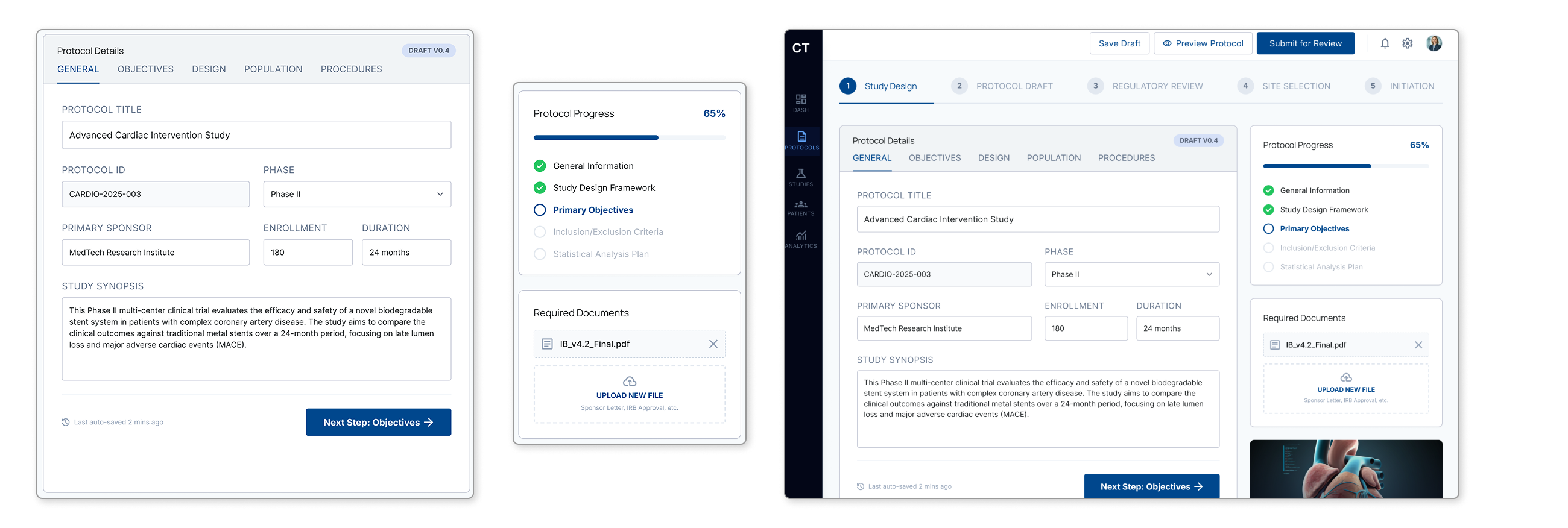
Protocol CreationBuilding a protocol involves many interdependent decisions across study design, objectives, population criteria, and required documentation. The wizard surfaces this complexity progressively, one section at a time, with a persistent progress tracker so coordinators always know where they are in the process and what is still required before submission.
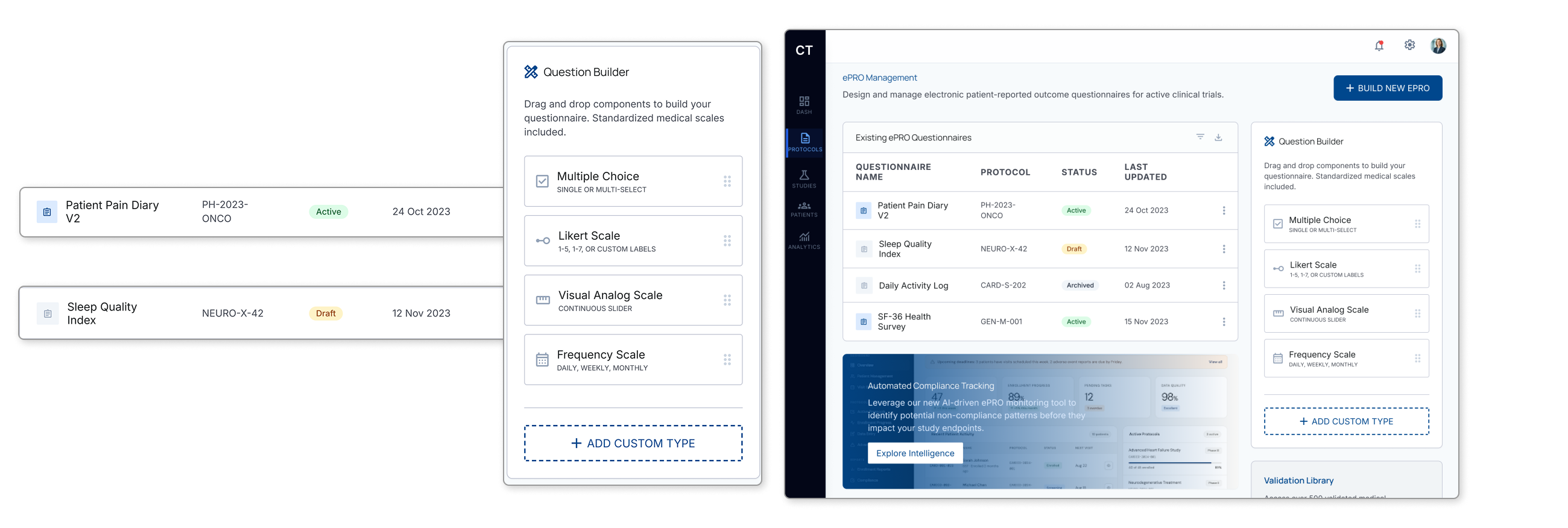
Electronic patient-reported outcomes required their own authoring environment. The Question Builder provides standardized medical scales out of the box, with the option to add custom types. The questionnaire library tracks each ePRO by protocol and status, so coordinators can manage active, draft, and archived instruments without losing context across trials.
Validation approach
- Every screen validated through SME sessions before moving to high fidelity
- Each screen had to prove it served a real need in the clinical trials ecosystem
Outcomes
From Developer-Led Confusion to User-Centered Clarity
Platform Transformation
- Portal transformed from developer-led confusion to user-centered clarity
- Role-based interfaces gave each user type the tools they actually needed
- SME validation secured with future testing milestones established
Design System Impact
- Component library adopted across multiple internal products
- Systems thinking from day one saved months of rework
- JIRA integration made design visible and valued across the team
Building components before screens, and grounding every decision in SME validation, created a platform that could scale. The design system outlasted the project.
The portal didn’t fully launch. The company pivoted.
Partway through development, the business shifted direction toward disease management. Clinical trials was deprioritized before it reached users. This happens in product work, especially at companies finding their market.
What didn’t get wasted was the work. Design, product, and engineering had invested heavily in the foundation: the component library, the role-based architecture, the validated workflows. When disease management became the priority, we carried those pieces forward. The design system transferred directly. Interaction patterns were repurposed. The research informed the next product’s user model.
A pivot isn’t a failure. It’s a redirection. The job is knowing what to salvage and what to let go.
What I’d Do Differently with Today’s Tools
AI amplifies human expertise, it doesn’t replace it. In regulated, high-stakes spaces, deep validation still comes from incredible humans like the SME.
AI-Powered Domain Crash Course
Use AI to pre-map clinical trial workflows and generate informed questions before SME sessions, making that time go even deeper.
Rapid Prototype Generation
AI-assisted component creation to test ideas faster and get to validated wireframes with less friction between concept and critique.
Smart Research Synthesis
AI to analyze SME session transcripts and surface patterns in real time, so insights don’t get lost between sessions.
What This Project Taught Me
Stay Curious
“Obvious” questions usually aren’t obvious. The best insights came from asking the thing that felt too basic to ask.
Find Your Champion
One great SME beats five lukewarm stakeholders. Depth of domain expertise is a design resource.
Operational Design is Design Strategy
Embedding work in JIRA made design visible and valuable. Process decisions are design decisions.
Systems Thinking from Day One
Building components before screens saved months of rework. The system you design for tomorrow shapes what you build today.